Designers & Companies

Tesselles

Françoise Lombaers and Guillaume Slizewicz © Cru_Atelier

Françoise Lombaers and Guillaume Slizewicz © Cru Atelier

After twenty years restoring heritage mosaics, Françoise Lombaers joins Guillaume Slizewicz to explore unmapped territory. Four algorithms—drawing from fungal networks, fractal patterns, and cellular automata—become mosaics where square tesserae generate unexpected organic movements. A quiet investigation into how ancient techniques might evolve.

Bio

At a time when traditional crafts struggle to find new practitioners and digital tools are revolutionizing the creative industries, mosaic art—which requires years of training—faces a dwindling pool of artisans while emerging artists flock to digital media. Rather than pit these worlds against each other, Lombaers and Slizewicz prove they can enhance one another: algorithms unlock formal possibilities beyond manual capability, while the tactile nature of mosaic grounds digital concepts in physical reality. 

This approach also meets growing market demand for unique pieces that blend cutting-edge technology with traditional craftsmanship. By making mosaic more accessible through generative systems, the duo is paving the way for a new generation of creators who can embrace this ancient art without mastering every traditional technique—a particularly relevant approach as AI tools challenge our understanding of craft's role in contemporary creation.

Objects

Ondes

The French term for «waves» describes oscillating patterns  created when frequencies modulate each other, like ripples meeting on a pond. Our algorithm calculates these patterns using radial distances from a central point and applies multiple octaves of fractal noise with decreasing amplitude. The resulting fluid gradients aims to create dynamism with square mosaic tiles, where creating movement is challenging. Unlike conventional techniques where artisans must cut tesserae into specific shapes to achieve flow, our approach generates wavelike patterns that can be translated directly using square tiles. This offers a contemporary alternative to traditional andamento techniques enabling fluid visual movement within the constraints of a modular grid system.

Winckelmans porcelain stoneware
2 x 2 cm, thickness 3.8 cm

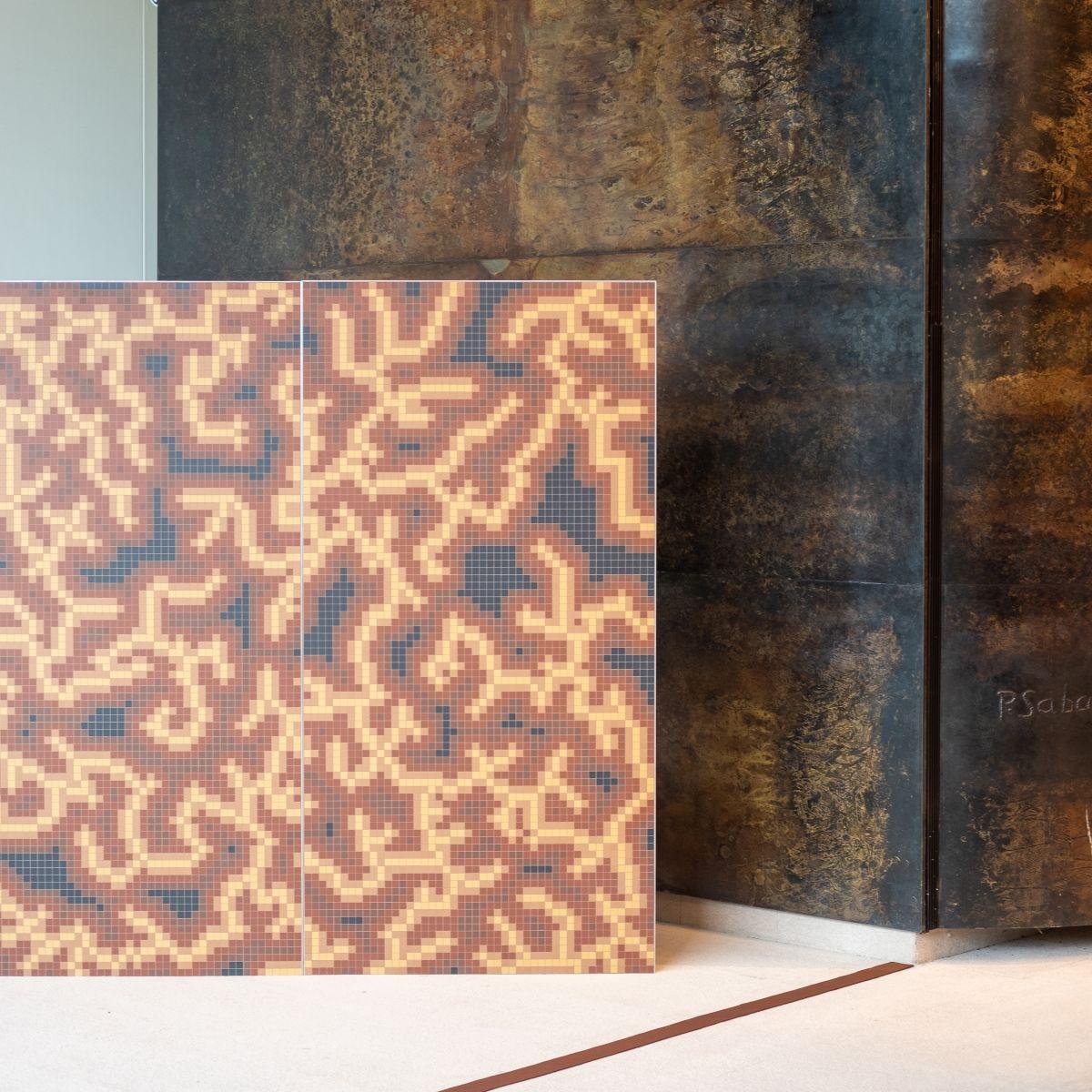
Prim-Jarník Algorithm

"In our interpretation of this graph algorithm, we explore the problem of connecting all points in a space using the minimum possible total distance. The algorithm grows a tree by repeatedly selecting the shortest possible edge that connects the existing structure to a new point. Rather than representing connections as present or absent, we apply a ridge gradient that creates a topographical landscape where the tree's edges form elevated ridges that gradually taper off into valleys. This approach transforms the mathematical precision of finding optimal connections into organic, flowing patterns that can evoke natural systems like river networks or leaf veins."

Winckelmans porcelain stoneware
2 x 2 cm, thickness 3.8 cm